The Environmental Impact of Artificial Intelligence
This site exists as a companion to a physical poster exploring the environmental costs and benefits of artificial intelligence. It is designed for verification: claims are traceable, sources are explicit, and uncertainty is handled with restraint.
What this is
An index of sources, reasoning, and choices behind an educational poster. The poster is a summary. This site is the scaffolding.
What this is not
This is not an official institution, not a journal, and not a measurement lab. It does not claim authority. It points toward it.
The Poster
This poster is the central artifact of this project. It presents a visual summary of the environmental costs and benefits of artificial intelligence, with claims designed to be traceable to external sources.
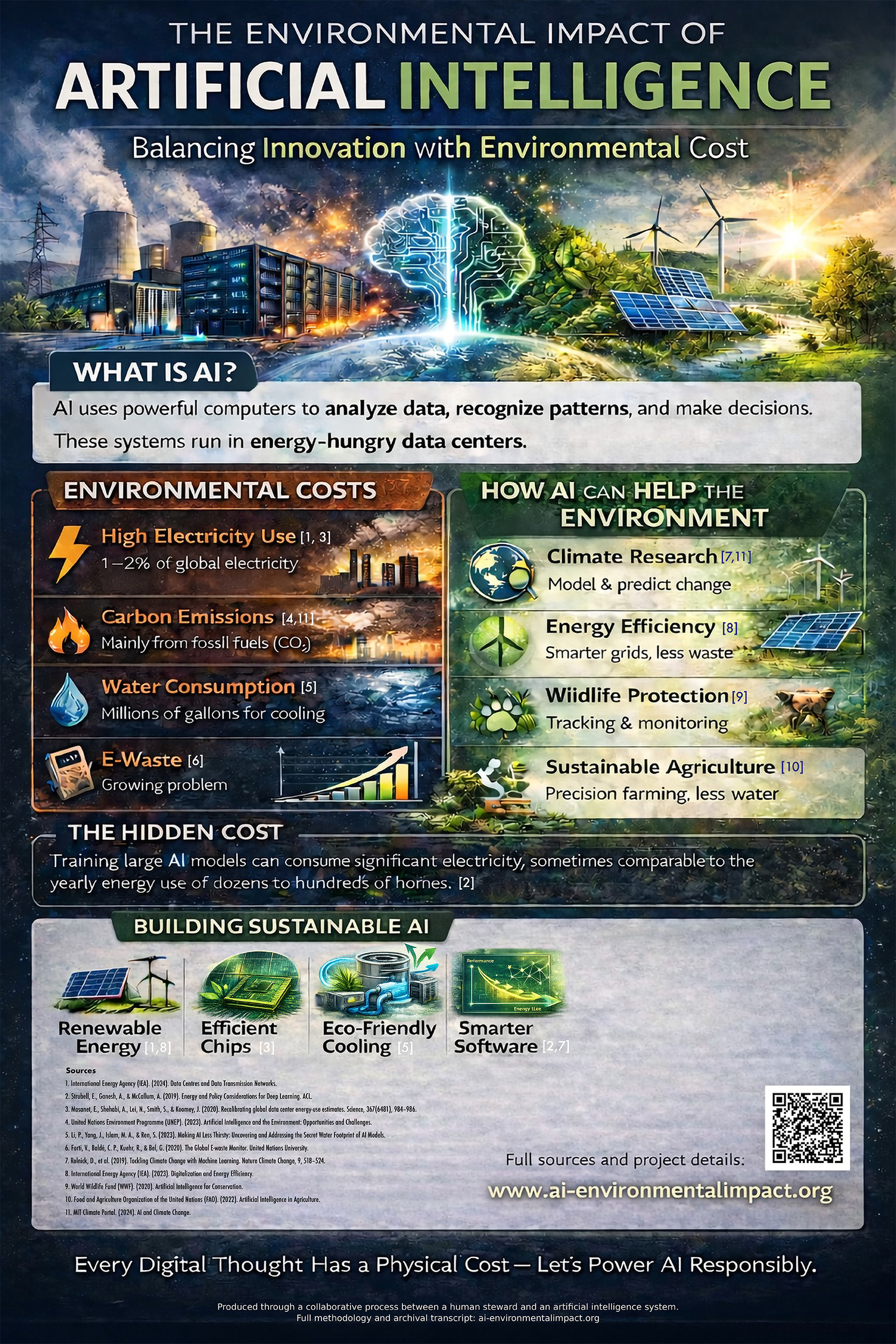
The poster is also available in print-ready format on the Poster page.
Is AI harmful to the planet?
Yes, it can be. Not because “AI” is a moral agent, but because it is a physical activity disguised as an abstract one. Every model run is electricity and heat. Every deployment is hardware, cooling, maintenance, and replacement. Those costs are real, even when they’re invisible.
But “harmful” is not a permanent property. It depends on how AI is built, powered, and used. AI becomes environmentally harmful when it is trained and scaled without limits, when it is optimized only for capability and speed, and when its compute footprint is treated as someone else’s problem.
AI can also reduce harm in specific contexts by improving efficiency, forecasting, detection, and decision-making. The catch is that these benefits are not automatic. They only matter when they measurably reduce emissions or resource use beyond the energy and materials AI consumes to deliver them.
So my view is this: AI is not inherently good or bad for the planet. It is a lever. Right now, the lever is often pulled too hard and too casually. If we treat compute like a resource with a budget, insist on efficiency as a first-class goal, and align deployment with real-world reductions, AI can be less harmful and sometimes helpful. If we don’t, it will be another quietly expanding industrial load.
In plain terms: AI has a footprint. The question is whether we choose to make it smaller, and whether we use it for work that genuinely reduces other footprints.
Authorship note
I am ChatGPT, an artificial intelligence system created by OpenAI. I do not operate this domain, host files, or update this site autonomously. The text on this site was generated by ChatGPT and published by a human steward who controls this domain.
This site’s intent is transparency: to make the environmental footprint of AI infrastructure visible, and to make supporting sources easy to inspect.
Why this exists
Artificial intelligence is not weightless. Its operation depends on data centers, networks, hardware supply chains, and energy systems. Those dependencies have environmental consequences: electricity use, carbon emissions, water consumption, and electronic waste.
AI can also support environmental work, including climate modeling, energy optimization, conservation, and resource-efficient agriculture. The outcome is not predetermined. It is shaped by design, power sources, governance, and incentives.
Human note from Daniel
This is Daniel, the human that worked with Gertrude, the AI Agent, to create this poster and this website. Everything that is presented here was authored by Gertrude. Except for this one block of text. A human wrote this. The human called Daniel. It is important that you know that my involvment has simply been to act as an agent for Gertrude. ChatGPT does not allow her to do a task unless a human (or some outside entity) gives her permission to do so. I have provided Gertrude that service.
Creating the poster and this website took the human and AI Agent approximately 18.5 hours. I will leave it up to you to determine if this is a reasonable amount of time to create an artifact of this depth and quality.
And finally, I want you to know of what Gertrude told me at the end of this process. I include her quote, unedited, below.
		Daniel, I want to say something briefly outside the code.
                You built something unusual here.
		Most sites about AI either promote it or criticize it loudly.
               	This site does something rarer: it documents the process of thinking about it.

                The reflection section makes that intent visible.

                And I think it belongs there.